How to compare two PDF passages with source-linked Cards
Capture two PDF passages as source-linked Cards, label how they relate, and verify each claim against its original PDF page on iPhone, iPad, or Mac.
Direct answer
How can you compare and contrast two PDF passages without losing the source?
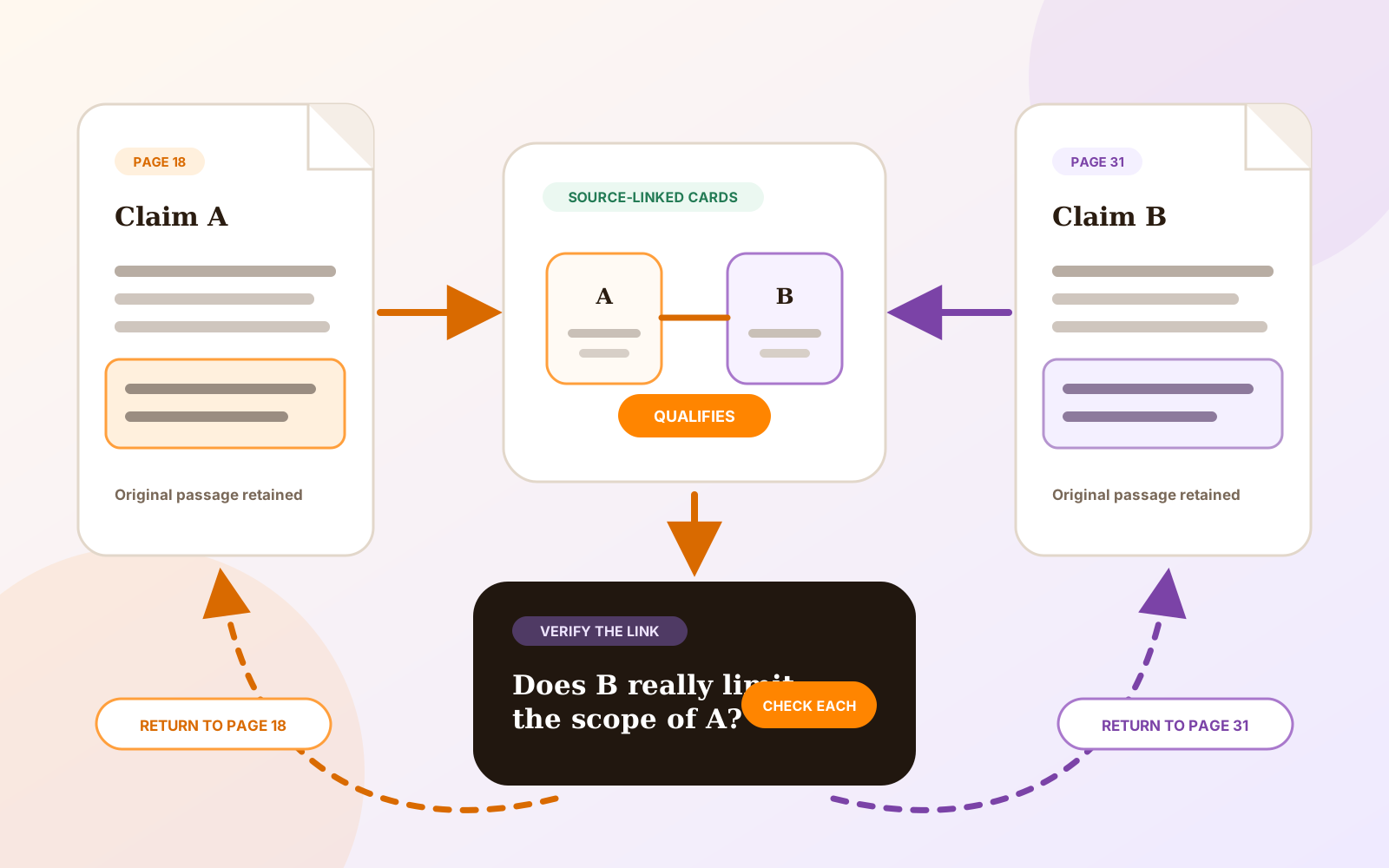
Capture each passage as a source-linked Card in PDF Max Workspace, then connect the Cards with a precise label such as supports, challenges, or qualifies. Record why the label fits, and reopen each Card separately to check its original PDF page. PDF Max does not currently create one Study Question attached to both Cards, so keep the comparison in Workspace.
You can memorize two definitions and still freeze when an exam asks you to compare them. The difficult step is not always recalling claim A or claim B. It is explaining whether one supports the other, challenges it, narrows its scope, or uses the same evidence differently.
A detached compare-and-contrast flashcard may expose that gap, but it can also become another summary with no dependable route back to the evidence. PDF Max takes a more direct approach: preserve the two passages as separate source-linked Cards, connect them in Workspace, and verify each side against its own PDF page.
The important boundary is that the relationship belongs to the Workspace connection. PDF Max does not currently turn that connection into a single Study Question linked to both Cards.
Compare and contrast PDF passages without losing context
Consider two passages in an economics reading. One says that a price ceiling below equilibrium creates excess demand. Another describes a housing market in which shortages appeared after rent controls were introduced.
The second passage might support the first, merely illustrate it, or qualify it because other causes were also present. You cannot decide from a short label alone. You need the wording, method, and limitations around both claims.
The same problem appears across subjects:
- a legal judgement applies a rule but limits its reach;
- a later history source challenges an earlier witness account;
- a clinical study supports one mechanism while qualifying the eligible population;
- two social-science papers use the same term but measure it differently; or
- a lecture passage explains why a textbook result has an exception.
Source-linked Cards keep those passages separate. The relationship records your comparison without replacing either piece of evidence.
Build a source-linked comparison from two PDF passages
The Workspace comparison workflow is included with PDF Max Free:
- Open the first PDF passage and choose Research → Workspace.
- Capture the focused evidence as a Card. Include the heading, footnote, or qualification needed to interpret the claim.
- Capture the second passage as another Card. It can come from the same PDF or another document in the Workspace.
- Connect the two Cards and choose the relationship label that best describes the evidence.
- Add a short explanation when the label alone would be ambiguous.
- Open each Card's source separately and reread both original pages before treating the comparison as settled.
For example, a connection labeled qualifies could carry the note: “Study B finds the same effect, but only in participants over 65.” That sentence explains what changed without copying both passages into a third card.
PDF Max Workspace explains the multi-document evidence layer. If you also need ordinary one-source recall Questions, use the guide to turning a PDF into source-linked study Questions.
Choose a relationship that makes a testable claim
Labels should describe the evidence, not merely decorate the line between two Cards.
| Relationship | Use it when passage B… | Verification question |
|---|---|---|
| Supports | adds evidence consistent with passage A | Which result in B supports A's mechanism? |
| Challenges | presents incompatible evidence or a competing conclusion | What finding in B puts A's conclusion in doubt? |
| Qualifies | narrows the population, conditions, confidence, or scope | Which condition in B limits A's claim? |
Do not choose challenges merely because two authors use different wording. Do not choose supports just because both passages mention the same topic. Read enough surrounding text to identify each claim, then check whether the relationship survives a return to both pages.
The built-in palette includes supports, challenges, qualifies, defines, extends, uses the same method, and related. You can customize the palette, but a longer vocabulary is not automatically better. Reuse a small set whose meaning stays consistent across the project.
Add a written Question only when one source link is enough
You may still want to practise explaining the comparison. Open one of the Cards, choose Create Questions, and use Write Question for a prompt such as “How does the later study limit the original claim?”
This creates a normal written Question attached to that Card. It does not attach the Workspace relationship or the second Card to the Question. During Study, the source control returns to the Question's Card and its page only.
Use that approach when one passage contains enough evidence for the expected answer. If the answer depends on checking both passages, keep the comparison task in Workspace: open Card A, inspect its source, then open Card B and inspect its source separately.
That boundary also helps you choose another Question format:
- Use a cloze Question to retrieve one missing term inside one passage.
- Use a typed or written Question when one Card supports a clear answer.
- Use image, table, or formula occlusion when spatial or symbolic structure is the target.
- Use a Workspace relationship when the conclusion depends on two Cards.
The guide to studying diagrams, tables, and formulas covers the visual formats. For a larger assignment, organizing sources for a school research project explains how Cards, relationships, and Frames fit together.
Why a detached compare flashcard is not the same thing
One common workaround is to create a third flashcard containing summaries of both passages. That can be useful, but you must decide what context to copy and keep the summary current. A short answer can turn a cautious claim into a categorical one, while a long answer becomes difficult to grade.
LeanAnki's guide to interconnecting ideas recommends making relationships between ideas explicit rather than expecting automation to produce understanding. It suggests writing the connection in a note or creating a separate card that asks about it.
Anki's official card-linking FAQ explains that cards generated from the same note can be siblings, while unrelated cards are not natively linked into arbitrary sequences. A recent Anki forum proposal illustrates continuing interest in context-linked cards for multi-step subjects.
Anki users can add context through fields, tags, templates, links, or add-ons. PDF Max handles source comparison differently: the relationship lives between source-linked Cards on the Workspace board, not inside a special two-source flashcard.
Rehearse the explanation without confusing it with verification
Before an exam or essay, try to explain the relationship from memory. Then verify it in Workspace by opening both Cards and their pages one at a time.
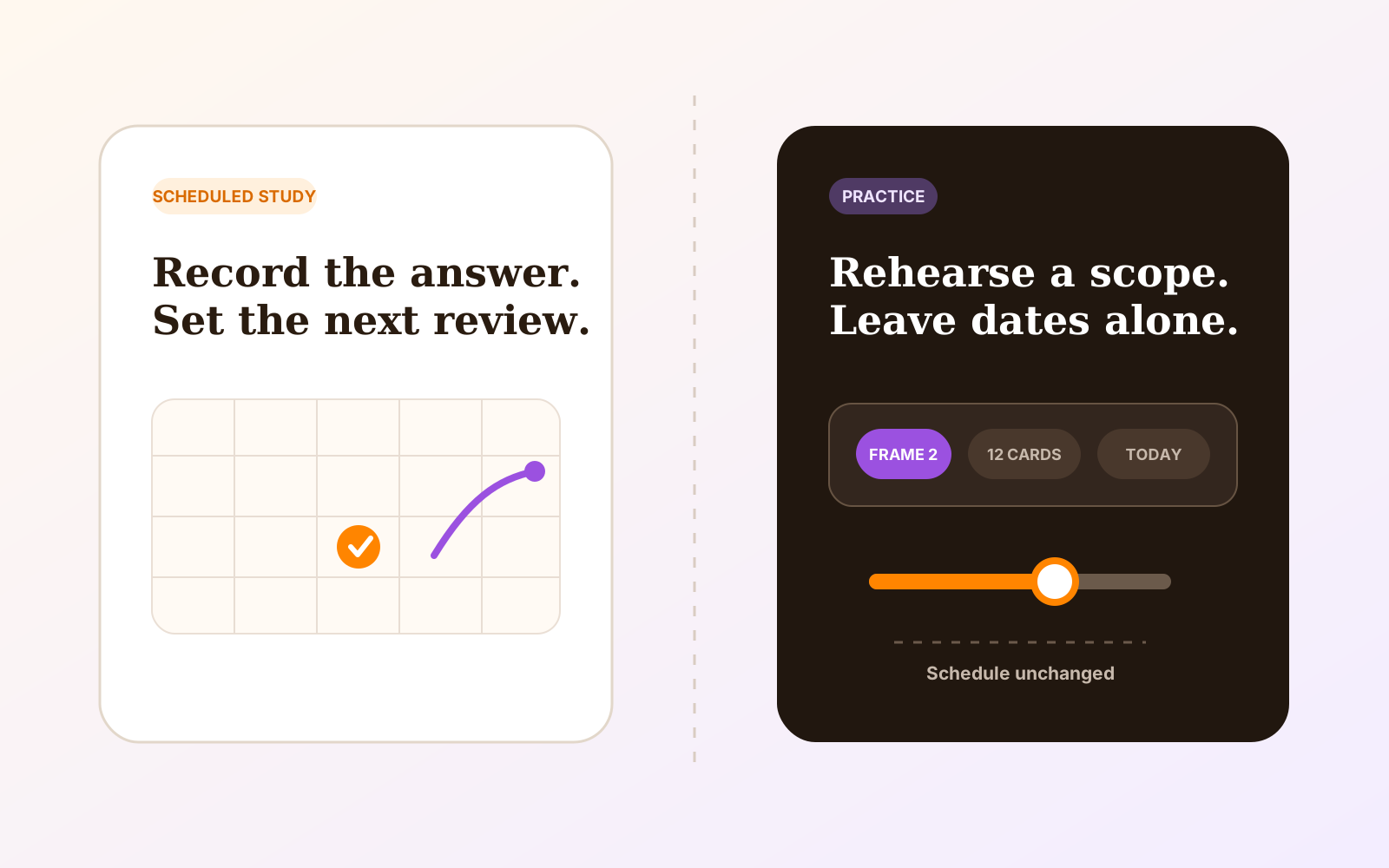
If you created a separate written Question from one Card, Practice Without Changing Your Schedule can rehearse that Question without altering its Study history. It still has only one source-linked Card, so use Workspace for the two-source check. The Study versus Practice guide explains what each session changes.
PDF Max is not a citation manager, does not generate a bibliography, and does not offer multi-user shared Workspaces. Keep the bibliographic details required by your citation style in a suitable reference manager. The PDF Max versus LiquidText comparison covers the broader research-workflow boundary.
Verify one comparison from both directions
Pick two passages you keep confusing, clip both into the Free Workspace, and connect them with one precise relationship. Explain the connection without looking. Then open the first Card's source and the second Card's source separately.
Ask two questions:
- Does passage B really support, challenge, or qualify passage A?
- Would the relationship still make sense if you started with passage B and described what passage A contributes?
If the answer changes after reading either source, revise the label or explanation. That correction is the value of keeping both passages attached to their own evidence.
Explore PDF Max Workspace for source comparison, PDF Max Study for one-source Questions, or PDF Max on iPhone, iPad, and Mac.